What a tripping breaker is actually telling you
There are three different faults behind almost every tripping breaker, and they do not carry the same urgency.
September 8, 2026 · 4 min read
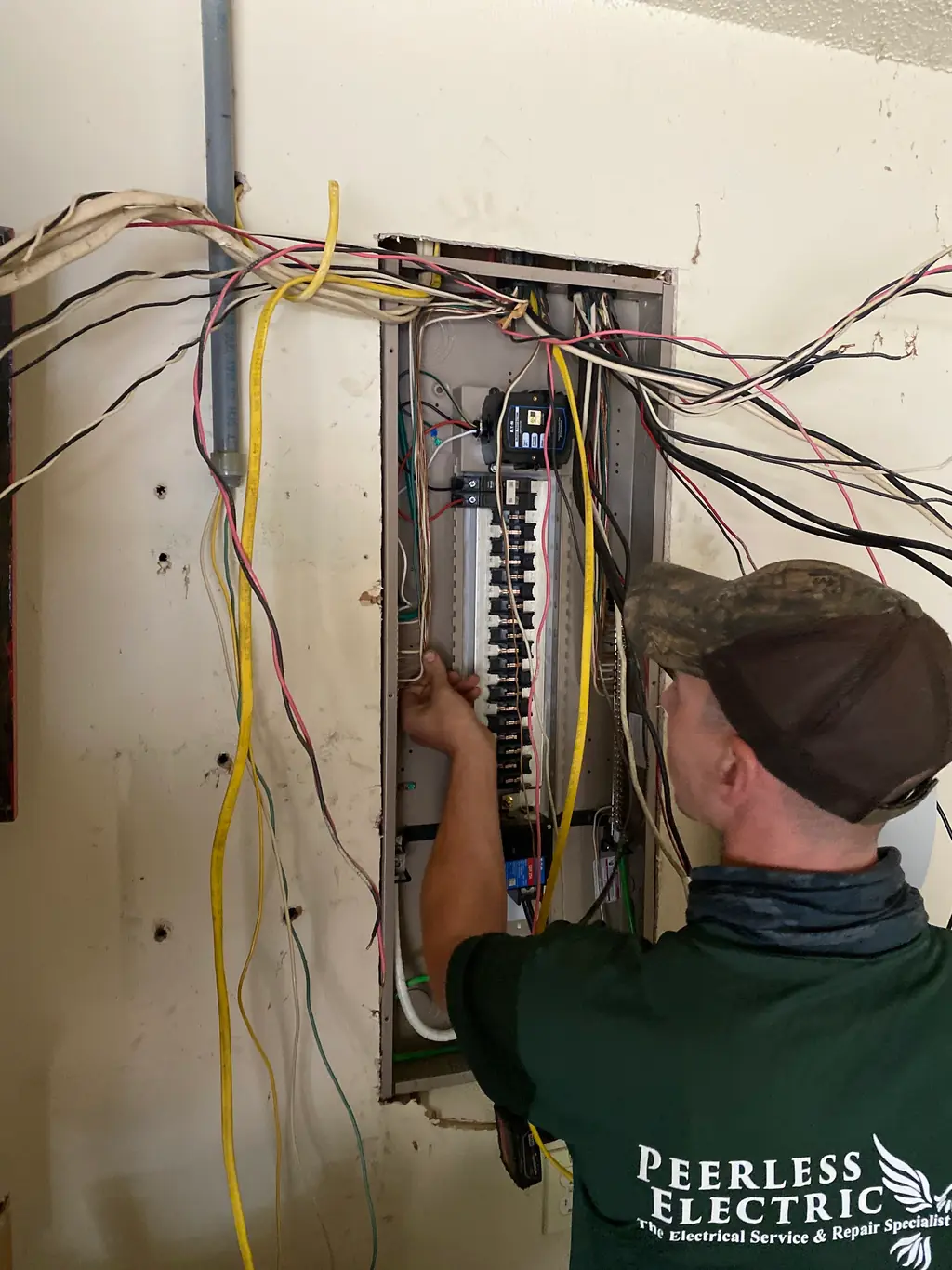
The most common thing we hear on the phone is that a breaker keeps tripping and the caller wants to know whether that means the breaker has gone bad. Occasionally it does. Far more often the breaker is the one component in the situation doing exactly what it was designed to do, and the useful question is what it is protecting you from.
A breaker opens for three broadly different reasons, and once you can tell them apart you have a much better sense of whether this is a call today or a call next week.
Reason one: the circuit is simply overloaded
This is the friendliest of the three. A circuit is rated to carry a certain current continuously, and you have asked it to carry more. The classic version in a Hurst or Bedford house is a kitchen counter circuit with a toaster and a kettle on it, or a garage circuit running a freezer that is now sharing with a compressor.
An overload has a signature: it takes a little while to trip, it trips when you add the last appliance, and it does not trip if you move that appliance to another room. The breaker is warming up and opening thermally, which is deliberate and slow.
The fix is rarely a bigger breaker. Putting a larger breaker on the same wire removes the protection without changing the wire's ability to carry current, which is how an overload problem becomes a fire problem. The right answers are to redistribute the load, or to run a dedicated circuit for whatever is pushing it over.
Reason two: a short circuit
A short trips instantly and hard. There is no gradual warming up. Very often it happens the moment something is plugged in or a switch is thrown, which is a useful clue because it points you straight at the device or the part of the circuit involved.
A damaged appliance cord is the most common culprit and the easiest to rule out: unplug everything on the circuit, reset the breaker, and add things back one at a time. If the breaker holds with everything unplugged, the problem travelled into the house on a cord rather than living in the wall.
If it trips instantly with nothing plugged in, the fault is in the fixed wiring, and that is a call. Something in a box, a fixture, or a cable run is making contact where it should not.
Reason three: a ground fault
If the device that trips is a ground fault outlet or breaker, it is watching for current leaving the circuit through a path that is not the neutral, which in the worst case is a person. These belong in kitchens, bathrooms, garages, laundries and outdoors precisely because those are the wet locations.
Ground fault devices trip on moisture with some regularity, and an outdoor receptacle that trips after heavy rain is often telling you that water has found its way into a box or a fitting. That is worth fixing rather than working around, because the water is not going to stop arriving.
The four signs that change the urgency completely
Everything above assumes the only symptom is the trip itself. Any of the following means stop using the circuit and phone an electrician rather than resetting it again:
- A burning smell anywhere near an outlet, a switch or the panel
- An outlet, switch or cover plate that is warm to the touch
- Scorch marks or brown discolouration around a receptacle
- A breaker that trips again the instant it is reset, repeatedly
All four are symptoms of heat, and heat in an electrical system means current is crossing a gap it was never intended to cross. That is arcing, and arcing is a fire risk long before it is an inconvenience. It can also draw too little current to trip a conventional breaker at all, which is exactly why arc fault protection exists as a separate device.
Why we take the panel cover off first
Whatever the symptom at the wall, we start at the panel. That is where you can see conductor condition, how the neutrals and grounds are landed, whether anything has been backstabbed or double tapped onto a breaker, and what the real load looks like against the bus rating.
In a great many older houses across the tri-cities the recurring fault turns out to be a loose or corroded connection rather than a failed device, and it is at the panel rather than at the outlet where the trouble was noticed. You cannot see any of that from the front of a panel, which is why nothing should be quoted from there.
If your breaker is tripping and none of the four warning signs are present, you have some room to work through the list above yourself. If any of them are, that is a today call.
Peerless Electric · (817) 373-5720
Call (817) 373-5720More articles
Federal Pacific and Zinsco panels: what to do if your house still has one
The problem with these panels is not that they are old. It is that the breaker may not open when a circuit faults.
Why three prong outlets in an older house often have no ground behind them
A three slot outlet is a promise about what is behind the wall. In a lot of older houses that promise is not kept.