03
Rewiring and aluminum wiring
Cloth wire, ungrounded two prong circuits and aluminum branch wiring are all normal findings in the tri-cities' older streets. None of them has to be fixed in one week, and we plan the work so you can keep living in the house.
Chapter 01
What is actually behind the walls here
Housing across Hurst, Euless and Bedford spans several distinct wiring eras, and each leaves a different problem. Rubber and cloth insulated conductors become brittle and shed their covering at the terminations first, which is why the trouble usually appears in a box rather than in the middle of a run.
Ungrounded two wire circuits are extremely common, and they are the reason a house can have three prong receptacles with no ground behind any of them. That is not a cosmetic issue: surge protection, and any equipment that expects a ground path, depend on something the outlet is only pretending to have.
Aluminum branch circuit wiring from the late sixties and seventies is its own case. It is not a fault by itself, but aluminum and copper expand at different rates, so the connections loosen over years of heating and cooling. The fix is at the terminations, not necessarily a whole house rewire.
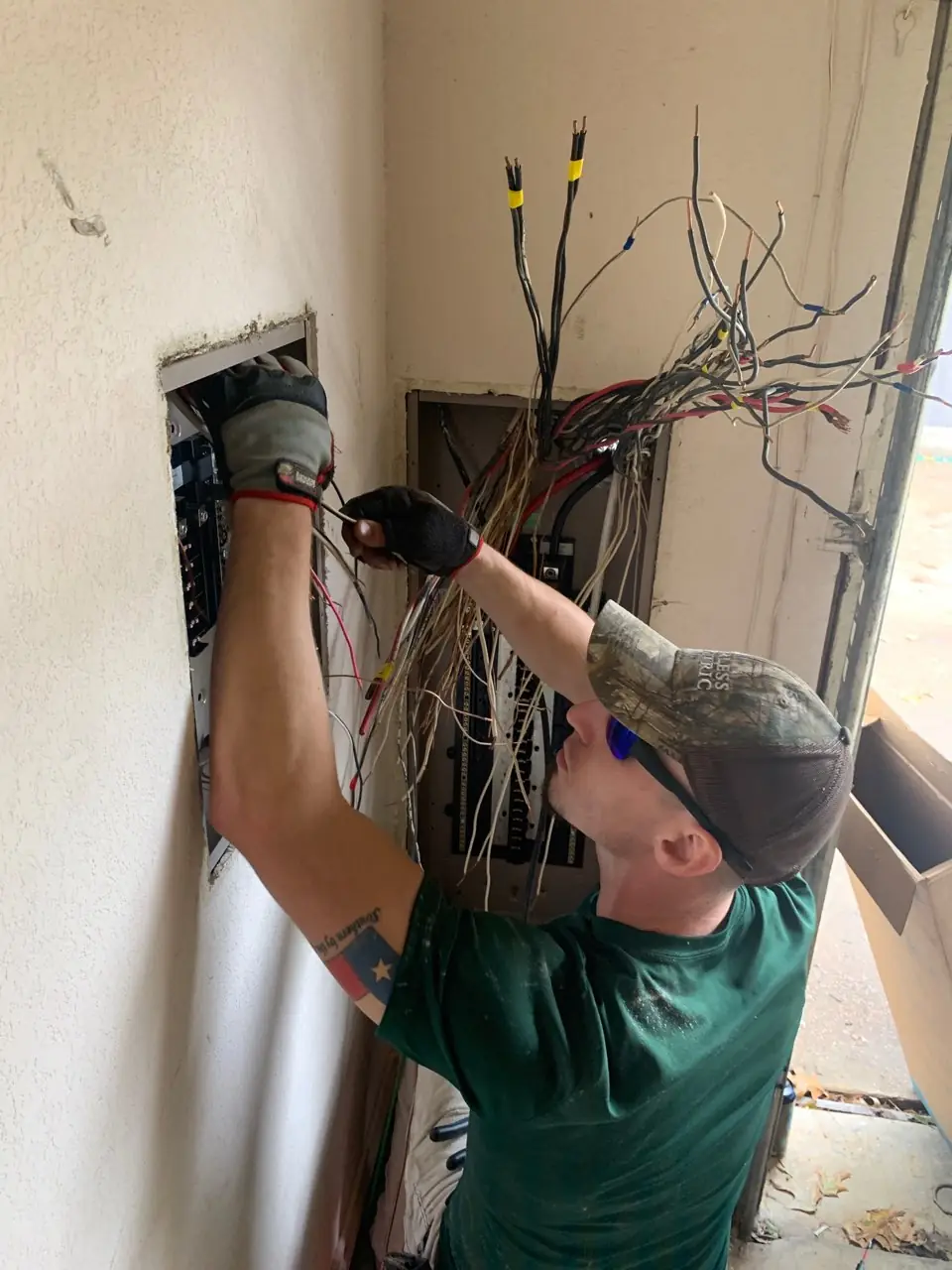
Peerless Electric technician mid rewire, reaching into an open service panel with a cut bundle of conductors
Aluminum wiring solutions, in order of how invasive they are
The least invasive approach is to correct the terminations, pigtailing to copper at every device and splice with connectors listed for the aluminum to copper transition, and using devices rated for aluminum where devices are staying. For a great many houses this is the proportionate answer and it is what we recommend.
Where the aluminum has already overheated at multiple points, or where a renovation is opening the walls anyway, replacing the branch circuits becomes the sensible call. That is a judgement made from what we find in the boxes, not a policy we apply to every aluminum house that calls.
We will tell you which of the two you are looking at, and we will tell you if the honest answer is that your aluminum is in good condition and wants monitoring rather than money.
Chapter 03
Rewiring in stages you can live in
A whole house rewire does not have to happen as one displacement event. We commonly stage it: the panel and the highest risk circuits first, then kitchens and bathrooms where ground fault and arc fault protection matter most, then bedrooms and general lighting.
Staging changes the access plan too. Attic runs, closet chases and existing openings do a lot of work in an older single storey house, and every route we can take through those is drywall we do not have to open. We walk the house and agree the route before anything is cut.
What we will not do is quote a stage in isolation and let you discover later that the sequence made the next stage more expensive. The plan gets laid out as a whole even when the work is bought a piece at a time.
Grounding, protection and sign off
Rewiring is the point at which grounding and bonding get brought properly up to code, which is the part of the job nobody sees and everything else relies on. Arc fault and ground fault protection goes in where the code requires it.
Every circuit that goes back in gets labelled at the panel for what it actually feeds. The work is completed to the applicable local and national electrical codes and taken through inspection.
Family owned in Euless since 1981 and into a second generation. Licensed Master Electrician TMEL#26724. Free estimates on most work.