07
Electric car charger installation
A home charger is a large continuous load on a service that was probably never sized for one. The install is straightforward. The part worth getting right is the arithmetic before it.
Chapter 01
The load calculation comes first, always
A Level 2 charger is a continuous load, which means the circuit has to be sized above the charger's draw rather than to it. On a house that already has electric heat, a couple of air conditioning systems or an electric range, that can be the difference between fitting on the existing service and needing a service change.
So the first visit is a load calculation against what the house actually runs today, plus anything you already know is coming. It is far cheaper to discover a capacity problem before a charger is bought than after it is on the wall.
Where the service genuinely will not carry it, there is usually more than one route: a service change, or a load management device that lets the charger share capacity intelligently with the rest of the house. We will lay both out with honest prices rather than defaulting to the bigger job.
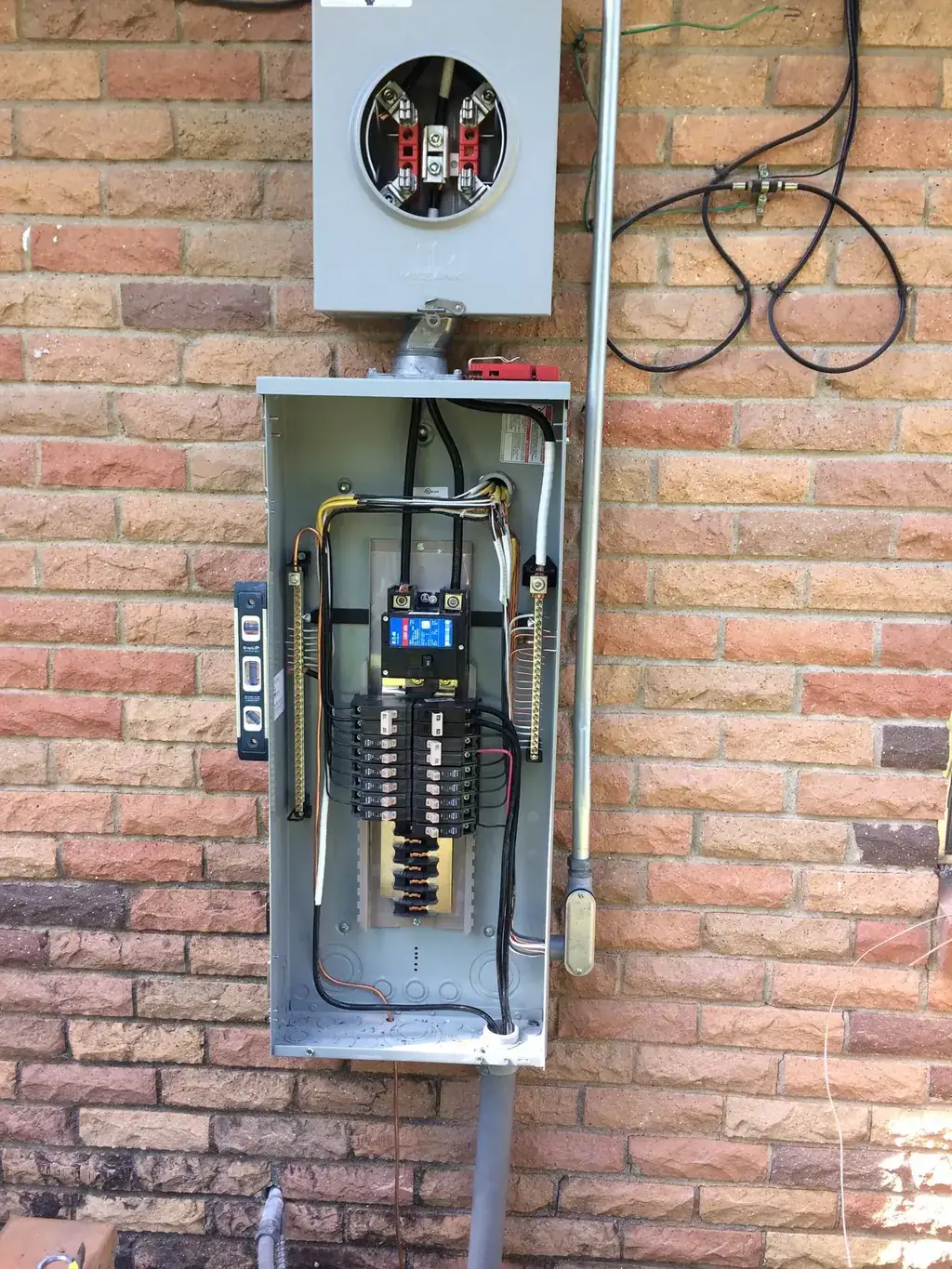
Finished exterior service panel and meter installed cleanly on a brick wall by Peerless Electric
Where the charger goes, and why that decides the price
The single biggest variable in a charger install is the distance and the route from the panel to the parking spot. A panel on the garage wall is a short run. A panel on the opposite side of the house, or a detached garage across a driveway, is a different job entirely.
We walk it before quoting: the run length, whether it can go through attic or crawl space rather than across a finished ceiling, whether any of it is exterior and therefore needs conduit and wet location fittings, and which side of the car the charge port is actually on.
That last one sounds trivial and is not. A charger mounted on the wrong wall of a two car garage means a cable stretched across the second bay for the life of the car.
Chapter 03
Hardwired or plug in, and permits
Both are legitimate. A hardwired charger is generally the better answer outdoors and for higher amperage units. A plug in unit on a suitable receptacle is easier to swap out later and easier to take with you, which matters if you might move.
Either way the circuit is dedicated, protected as the code requires for the location, and the work is permitted and inspected. This is not a job to leave undocumented: it is a large continuous load and an insurer or a future buyer may reasonably ask about it.
We work Eaton, Siemens and Cutler Hammer gear, so the breaker going into your panel is matched to the panel rather than approximated.
Licensed Master Electrician TMEL#26724, Electrical Contractor TECL#20957. Free estimates on most work, and a five percent discount for seniors and military.