Federal Pacific and Zinsco panels: what to do if your house still has one
The problem with these panels is not that they are old. It is that the breaker may not open when a circuit faults.
September 8, 2026 · 4 min read
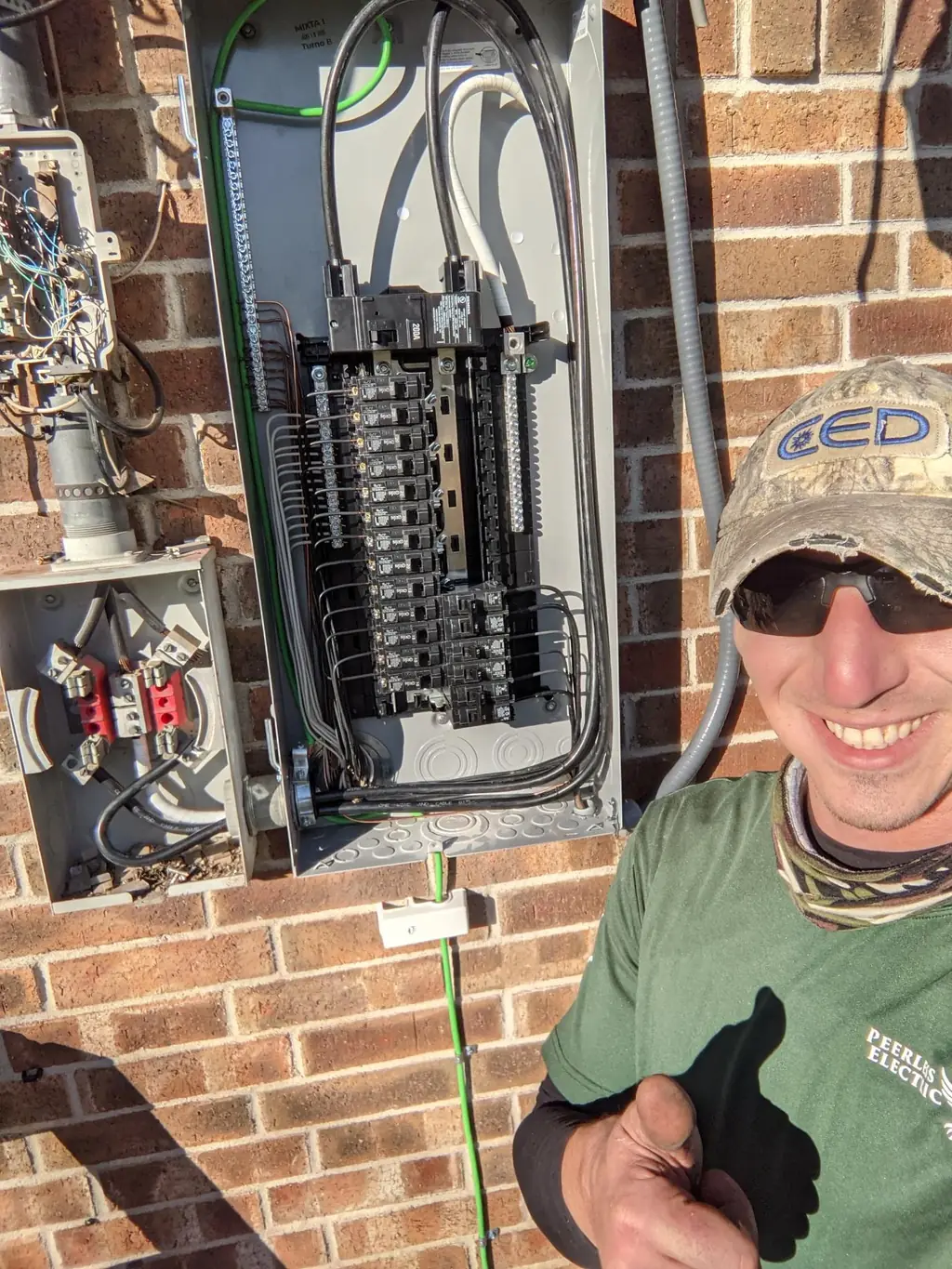
Two panel brands come up again and again when we open covers in northeast Tarrant County, and both come up for the same reason. Federal Pacific Stab-Lok and Zinsco panels have a documented history of breakers that do not reliably trip when the circuit they protect develops a fault.
That is a different category of problem from an old panel that is simply full, or ugly, or short of arc fault protection. A breaker that fails to open is the safety device quietly not working, and nothing downstream of it tells you that has happened. The house behaves normally right up until the moment it matters.
How to tell what you have without opening anything
You do not need to remove the cover to identify most panels, and you should not. The brand name is usually printed on the panel door, on the label inside the door, or moulded into the dead front.
- Federal Pacific panels are commonly labelled Federal Pacific Electric or FPE, and the breakers themselves are often marked Stab-Lok
- Zinsco panels may say Zinsco, or Sylvania Zinsco, or GTE Sylvania on the label
- Zinsco breakers are frequently identifiable by their coloured handles, which stand out against the more usual black
If the label is gone or unreadable, a photograph of the panel door and the breaker handles is usually enough for us to tell you over the phone before anyone comes out.
What actually goes wrong inside them
In the Federal Pacific case, testing over the years has found a meaningful proportion of Stab-Lok breakers failing to trip on an overload or a short. A breaker that does not open leaves the fault current running in the wire, and the wire then does the heating instead of the breaker doing the disconnecting.
In the Zinsco case the issue is more often the connection between the breaker and the bus. The bus material can degrade where the breaker clips on, and a poor connection there heats under load. Once that has happened it tends to get worse rather than settle, because heat damages the contact further, which produces more heat.
Neither of these is something you can inspect your way out of from the outside, and neither reliably announces itself before it becomes serious. That is genuinely what makes them different from a merely old panel.
Replacing a breaker is usually not the answer
People reasonably ask whether they can simply replace the suspect breakers and keep the panel. In most cases that does not solve the problem. With Federal Pacific the concern is the breaker design itself, so a replacement of the same type inherits the same doubt. With Zinsco the concern is often the bus, which the breaker clips onto and which a new breaker does not fix.
There is also a supply reality. These are long discontinued lines, so replacement breakers are refurbished, salvaged or aftermarket, and their provenance is difficult to establish. That is a poor foundation for the one component whose whole job is to be trustworthy.
What a replacement actually involves
The first question is whether you need a panel change or a service change, and they are not the same job. A panel change swaps the panel and keeps the existing service conductors and meter. A service change means new conductors, a new meter can, and coordination with the utility, which carries a different timeline and a different price.
Which one you need comes out of a load calculation against what the house actually runs today, plus anything you already know is coming, such as a car charger or a shop subpanel. We would much rather have that conversation before the work is booked than discover it halfway through a day with the power off.
On the day, the power is off for the working part of it, so we agree the window in advance and start early. Grounding and bonding get brought up to current code as part of the work, because a new panel landed on an old ground system is only half a job. Circuits get re-landed and labelled as they go back in.
How quickly this needs to happen
If the panel is showing any sign of heat, which means a burning smell, warmth at the cover, discolouration around a breaker, or breakers that trip and reset oddly, treat it as urgent and stop loading the affected circuits.
If it is simply present and behaving, it is a plan rather than an emergency. It is worth doing, it is worth budgeting for, and it is worth combining with anything else you were going to ask an electrician for anyway, because the panel being open is most of the labour on several other jobs.
What we will not do is tell you a panel is dangerous when it is not. Plenty of old panels are perfectly sound and want nothing more than a proper look. These two brands are a specific case with a specific history, not a general argument that old equipment should be replaced.
Peerless Electric · (817) 373-5720
Call (817) 373-5720More articles
What a tripping breaker is actually telling you
There are three different faults behind almost every tripping breaker, and they do not carry the same urgency.
Why three prong outlets in an older house often have no ground behind them
A three slot outlet is a promise about what is behind the wall. In a lot of older houses that promise is not kept.