Why three prong outlets in an older house often have no ground behind them
A three slot outlet is a promise about what is behind the wall. In a lot of older houses that promise is not kept.
September 8, 2026 · 4 min read
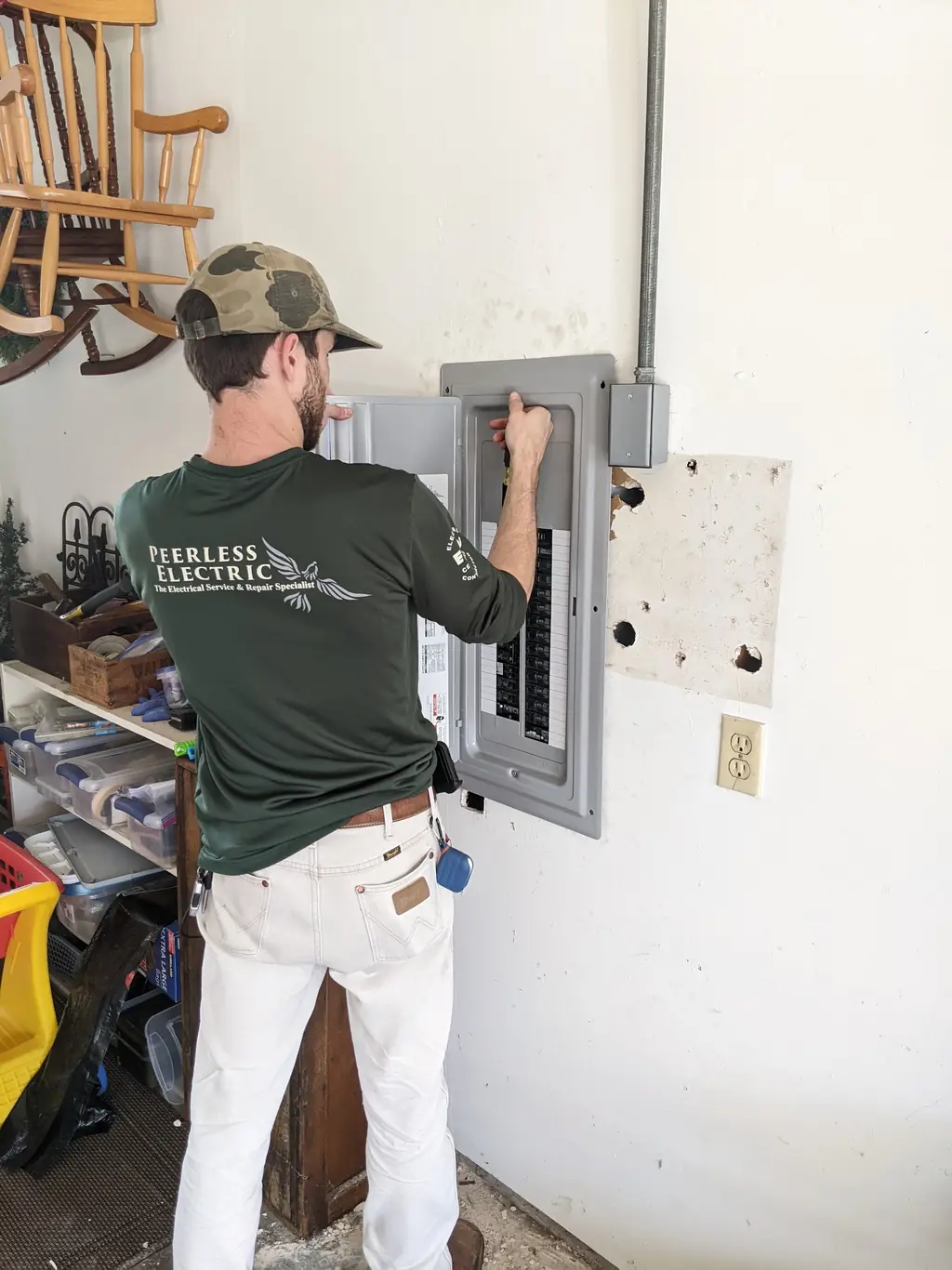
Here is a situation we find constantly in the older streets of Hurst, Euless and Bedford. The receptacles throughout a house have three slots, everything plugs in, everything works, and there is no ground wire connected to any of them.
It is almost never malicious. At some point somebody replaced a worn two prong outlet, the replacement they bought had three slots because that is what shops sell, and it went in without a ground because there was no ground conductor in the box to connect. The outlet now advertises a protection it cannot provide.
Why the ground pin is there at all
The ground gives fault current a deliberate low resistance path back to the panel. If a live conductor inside an appliance touches its metal case, the ground carries that current away and pushes enough of it through the breaker to make it open. Without the ground, the case can sit energised and wait for someone to touch it while touching something else earthed.
It also does quieter work. Surge protection depends on having somewhere to divert a transient to, so a surge strip plugged into an ungrounded outlet cannot do the job it was bought for. Some equipment uses the ground as a reference too, which is why an ungrounded circuit can produce odd behaviour in electronics that seems unrelated to wiring.
How to check your own outlets in about five minutes
A plug in receptacle tester costs very little at any hardware shop and reads out the common wiring conditions on a small set of lights. It will tell you an open ground, a reversed hot and neutral, and several other faults, and it takes seconds per outlet.
Two limits are worth knowing. These testers cannot detect a bootleg ground, which is where somebody has jumpered the ground terminal to the neutral inside the box. That arrangement satisfies the tester while creating a genuine hazard, because the neutral is a current carrying conductor and is not a safety path.
They also cannot tell you the quality of a ground that exists, only that something is connected. A high resistance ground can read as present and still not clear a fault quickly enough to be useful.
The three honest fixes, in order of cost
There is more than one legitimate answer, and they differ enormously in price. Any electrician who offers you only the most expensive one has not looked at your particular circuits.
- Protect the circuit with a ground fault device and label the receptacles as the code permits for a replacement without an equipment ground. This restores shock protection but does not create a ground path, so it does not restore surge protection
- Run an equipment ground to the circuit where the route allows it, which is often practical in a single storey house with attic access
- Rewire the circuit, which is the right call where the wiring is also aged, brittle or otherwise due, and where a renovation is opening the walls anyway
Which one applies depends on the circuit, the route, and what is on that circuit. The kitchen, bathrooms and anywhere a computer or a television lives usually deserve more than the cheapest option. A bedroom lighting circuit may not.
The one thing not to do
Do not connect the ground terminal to the neutral terminal in the box. It is a well known shortcut, it makes the tester show a correct reading, and it is dangerous. The neutral carries load current in normal operation, so a bootleg ground puts the metal case of your appliances onto a live current carrying conductor and relies on nothing going wrong upstream.
If a previous owner or a handyman has done this, a tester will not find it. An electrician taking the device out and looking will.
Where this fits in a bigger plan
Ungrounded circuits rarely arrive alone. A house that still has two wire circuits usually also has original conductors, an older panel, and no arc fault or ground fault protection anywhere. That is not a reason to panic, and it is not a reason to gut the house.
It is a reason to get a proper inspection and then work through it in an order that reflects risk. Kitchens, bathrooms, garages and outdoor circuits first, because those are the wet locations and the shock risk. Then the circuits with the most valuable equipment on them. Then the rest, on whatever timescale suits you.
One of our customers had a whole home inspection done and then called back later for the work she had decided she wanted, at her own pace. That is a perfectly good way to do it, and it is the shape we prefer.
Peerless Electric · (817) 373-5720
Call (817) 373-5720More articles
What a tripping breaker is actually telling you
There are three different faults behind almost every tripping breaker, and they do not carry the same urgency.
Federal Pacific and Zinsco panels: what to do if your house still has one
The problem with these panels is not that they are old. It is that the breaker may not open when a circuit faults.